
Lectionary Guides Archive
I create a visual guide to the Revised Common Lectionary and the Narrative Lectionary every week on THIS PAGE. Below are the archives of the posts, listed newest to oldest.
- Visual Lectionary for October 18, 2026 | Proper 24
- Visual Lectionary for October 25, 2026 | Proper 25
- Visual Lectionary for November 1, 2026 | Proper 26
- Visual Resources for November 1, 2026 | All Saint’s Day
- Visual Lectionary for November 8, 2026 | Proper 27
- Visual Lectionary for November 15, 2026 | Proper 28
- Visual Lectionary for November 22, 2026 | Christ the King
God Is With Us | Visual Resources for Advent 4, Love, and Both Lectionaries
This post offers visual resources for the week of December 18, 2022 in the Revised Common Lectionary and the Narrative Lectionary. It is the fourth Sunday of Advent and we light the candle of Love. It is also the great convergence where the Revised Common Lectionary and the Narrative Lectionary call for the same Gospel text. Matthew 1:18-25 tells the story of Joseph’s dream when a divine messenger tells him to take Mary to be his wife and they should name the child Jesus and call him Immanuel, God is with us.
The Light of Joy | Visual Resources for Advent 3 and Both Lectionaries
This post offers visual resources for the week of December 11, 2022 in the Revised Common Lectionary and the Narrative Lectionary. It is the third Sunday of Advent and we light the candle of Joy. John the Baptist questions Jesus from prison. Are you the one? Jesus comments that John is Elijah (RCL). Isaiah offers a picture of the Messiah as one who will shine a light for the nations (NL).
Longing for Peace | Visual Resources for Advent 2 and Both Lectionaries
This post offers visual resources for the week of December 4, 2022 in the Revised Common Lectionary and the Narrative Lectionary. It is the second Sunday of Advent and we light the candle of peace. John the Baptist calls the people of Israel into the wilderness to repent, be baptized, and to prepare themselves for the coming Kingdom of God (RCL), and Esther withstands the oppressive practices of her captor king and saves her people from genocide (NL).
Watching in Hope | Visual Resources for Advent 1 and Both Lectionaries
This post offers visual resources for the week of November 27, 2022 in the Revised Common Lectionary and the Narrative Lectionary. It is the first Sunday of Advent and we light the candle of hope. Jesus warns his disciples of the coming destruction of Jerusalem and tells them to watch and be ready (RCL) and the prophet Habakkuk warns Jerusalem of the coming destruction from the Babylonian Empire (NL).
Living in Dark Days | Visual Resources for Both Lectionaries This Week (Luke 23:33-43 and Isaiah 37)
This post offers visual resources for the week of November 20, 2022 in the Revised Common Lectionary and the Narrative Lectionary. Jesus is crucified between two criminals in Luke 23:33-43 (RCL) and Jerusalem is beseiged by the Assyrian Empire in Isaiah 36-37 (NL).
How to Live in Light of Coming Destruction in Luke and Micah | Resources for Both Lectionaries this Week
This post offers visual resources for the week of November 13, 2022 in the Revised Common Lectionary and the Narrative Lectionary. Jesus warns the people of Israel about the coming destruction of the Temple in Luke 21:5-19 (RCL) and Micah warns the people of Judah to prepare for their coming judgment (NL).
Life After Death (Luke 20) and The Healing of Naaman (2 Kings 5) | Visual Resources for Both Lectionaries This Week
This post offers visual resources for the week of November 6, 2022 in the Revised Common Lectionary and the Narrative Lectionary. Jesus is tested by the Sadduccess about the resurrection in Luke 20 (RCL) and Elisha heals Naaman in 2 Kings 5 (NL).
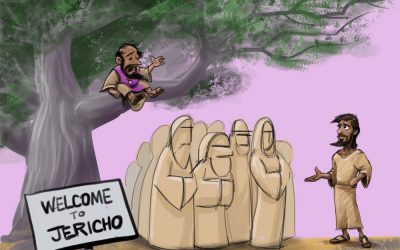
Zacchaeus (Luke 19) and Solomon (1 Kings) | Resources for Both Lectionaries on October 30, 2022
This post offers visual resources for the story of Zacchaeus in Luke 19 (the RCL text) and Solomon in 1 Kings (The NL text).

How to Read the Gospels
This presentation helps place the four Gospels of the Christian scripture in context. While Matthew, Mark, Luke, and John each paint a unique portrait of Jesus of Nazareth, they were all written within a similar historical, political, and theological context. This presentation sets that context for the reader that will help create a richer reading experience.
