

- This event has passed.
Visual Lectionary for November 1, 2026 | Proper 26

Visual Resources for the Lectionaries
This post offers visual resources for the Revised Common Lectionary and the Narrative Lectionary for November 1, 2026. Use this chart for quick links to the texts and the resource pages on cartoonistbible.com.
Proper 26
And it is ALL SAINTS’ DAY
(click here for resources)
CLICK HERE to jump to the Narrative Lectionary Resources
Revised Common Lectionary Resources
First Reading
Joshua 3:7-17

OR
Micah 3:5-12

Psalm
Psalm 107:1-7, 33-37

OR
Psalm 43:1-5
Second Reading
1 Thessalonians 2:9-13


Gospel Reading – Matthew 23:1-12
This image is from page 16 in A Cartoonist’s Guide to Matthew
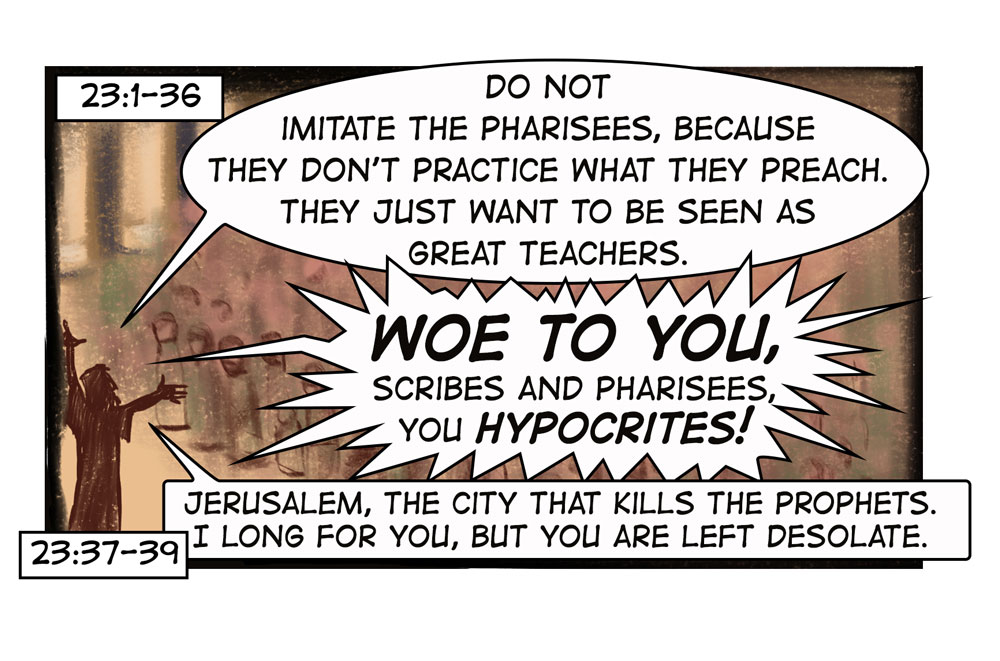
All who exalt themselves will be humbled, and all who humble themselves will be exalted.
Matthew 23:12 (NRSV)
Food for Thought
This week we observe two big days. All Saints’ Day, on Nov. 1 and All Souls’ Day on Nov. 2. Traditionally All Saints is a time to remember martyrs. These are people who were killed because of their testimony to Jesus Christ as Lord. All Souls is a day to remember all the faithful who have died. Many churches have simplified these days into one memorial service where we remember anyone who has died in the past year.
The challenge for the RCL preacher this year is the number of texts listed in the Lectionary. We are presented with Option I and II on Proper 26 plus the texts designated for All Saints. That’s a lot of reading!
As I was reading through all the texts there is one phrase that came to mind that ties them all together: Bearing Witness. The English word witness translates the Greek word martys. It is a legal term meaning one who has observed something and then gives a testimony to what they saw.
The church in the first few centuries suffered great persecution from religious leadership. Many people were executed for bearing witness—martys—to Jesus as the Christ and the Lord. This act of defiance to the power structures of the day and the subsequent public execution happened so often that the term martys became synonymous with giving one’s life for the name of Jesus. That is why we call them martyrs today.
The Gospel reading for Proper 26 continues our study of Jesus’ confrontations with the religious leaders in Jerusalem. This week he turns away from the leaders and speaks to the crowd, warning them not to follow these leaders. Jesus calls the leaders hypocrites. They are using their power to exalt themselves and to abuse those who are weak and marginalized. They are bearing false witness to the LORD they claim to represent.
This is the challenge to Christian Public Leaders this week. How are we bearing witness to Jesus? What version of Jesus do people see in how we lead those that God has entrusted to our leadership? May we soak in Jesus’ words in the beatitudes. Blessed are the poor in spirit, those who mourn, the meek, those who hunger and thirst for righteousness, the merciful, the pure in heart, the peacemakers, those who are persecuted for righteousness’ sake, those who are reviled and persecuted because they bear witness to Jesus.
Narrative Lectionary Resources

Food for Thought
We move from David’s sin with Bathsheba last week, in 2 Samuel, to King Solomon’s request for wisdom in 1 Kings 3.
Here’s what we skipped over:
- The son that was conceived from the rape of Bathsheba died.
- Bathsheba had another son from David. They named him Solomon.
- David had many wives and concubines and those women bore many children for David (Yes, this was a polygamous society and it was the cultural expectation that kings would form political alliances with other kingdoms by marrying daughters from royal families).
- A story of incest, murder and treachery among David’s children. Yes, this is the stuff that soap operas and Game-of-Thrones-ish tales are built on.
- As the elderly David is about to die, one of his many sons, Adonijah, claimed the throne for himself, threw a big party, and invited everyone except the leaders closest to David: Nathan the prophet, Zadok the priest, and Solomon the son of Bathsheba.
- Bathsheba petitions David for her son to take the throne.
- David gives the throne to Solomon.
- Solomon’s first act as king is to kill all who were opposing him and establish his own people in places of power.
- Solomon marries the Pharoah’s daughter.
- The people in Jerusalem were “sacrificing at the high places” because there was no designated place. This likely indicates that the people were continuing to blend Baal worship with the proper worship of the LORD.
This is a violent and complicated history. The challenge for the preacher is to find the Gospel message in these stories. How does the violent, polygamous, treacherous legacy of David and Solomon’s violent beginning make these characters worthy of our attention?
There is an important verse that happens right before our assigned reading. 1 Kings 3:3 says, “Solomon loved the LORD, walking in the statutes of his father David; only, he sacrificed and offered incense at the high places.”
Solomon was a mixed bag of goods. He sometimes did noble things. Our reading this week records Solomon’s prayer for wisdom and an account of how he made a brilliant decision to spare the life of an infant torn between two mothers. Yet, Solomon rarely acted wisely as a king. He eventually broke all the laws regarding a good king. He married foreign wives (thus bringing their gods into the palace), the amassed a huge army (thus conscripting men into the military), and he ammassed great wealth (thus taxing his own people and building an Empire on their backs).
Here are two take-aways for me:
First, we are all a mixed bag of goods. Luther got it right when he acknowledged that we are simultaneously sinner and saint. We are more like Solomon than we would like to think.
Second, the lessons of the Kings of Israel are cautionary tales. King Jesus does not follow the patterns of his ancestors. He is a different kind of king who does not use treachery and violence to establish his throne and dominate the world. He absorbs that violence into his own body on the cross, buries it, and sets the reboot button through the resurrection.
May we learn from the mistakes of the Kings of Israel and follow the King of Kings who sits as the lamb of God on the throne.
Download Everything for FREE!
Members of the Network will receive the following benefits:
Weekly Bible Study on Zoom
Every Monday afternoon a group of us join on Zoom from around the world to study the Bible together. We use the texts from the Revised Common Lectionary and the Narrative Lectionary for the upcoming Sunday as our focus.
Exclusive Content
Members of the Network get to download all of my resources for FREE, and there is content on the network that is not available anywhere else.
Access to the Art Pastor
I am very active and accessible on the Network. This is the best way to be in direct contact with me. I’d love to get to know you and how we can partner in God’s mission for your life.
Members Only Classes
I offer classes on the network that are not accessible anywhere else. These classes are asynchronous, so you can learn in your own time and space. Or, take a small group through it with you.
Get Weekly Resources Delivered Directly to You!
If you would like to wake up every Monday morning to the visual resources for the RCL and the Narrative lectionary waiting for you in your inbox, then fill out the form below. This email list will be used for only two reasons:
- to deliver weekly visual resources, and
- the occasional announcement of a new resource from A Cartoonist’s Guide to the Bible.
